
The AI Advantage: A Blueprint for Smarter Finance
AI is reshaping every part of finance, from automating accounting to enhancing auditing. In this 3-part series, we explore how AI is driving smarter decisions and stronger controls, starting with how finance teams can work faster and smarter.
AI IN FINANCE & ACCOUNTING
CH Ujjwal Kumar (ACA)
8/8/20257 min read


Part 1: How AI is Changing Accounting and Financial Processes — What It Means for Smarter Business Decisions
Let’s be honest — accounting hasn’t always been the most exciting part of running a business. It often feels like an endless cycle of entering invoices, chasing approvals, and staying up late to close the books. Then there’s the challenge of preparing reports for management that are both accurate and insightful.
But the good news? Artificial Intelligence (AI) is transforming all that. It’s not here to replace your finance team; it’s here to empower them. AI handles repetitive, time-consuming tasks so your people can focus on what really matters — growing the business, making smarter decisions, and strengthening controls.
Here’s how AI is already changing the game for companies — big and small.
Automation: Finally, Goodbye to Tedious Data Entry
If you’ve ever stayed late just to enter dozens — or hundreds — of invoices and reconcile statements, you know how exhausting and error-prone it can be. Now, imagine a system that can instantly scan thousands of invoices, pull out key details like vendor names, dates, and amounts, and post them directly into your accounting software. No typing, no cross-checking. Just seamless, lightning-fast processing.
Think about large companies like Walmart, D-Mart, Swiggy, or BigBasket. These giants deal with thousands of invoices every single week. Manually processing this avalanche of paperwork would be a logistical nightmare — draining hours, requiring massive teams, and increasing the risk of human error.
AI-powered automation offers a lifeline. By extracting, categorizing, and posting invoice data almost instantly, AI transforms what used to be a bottleneck into a smooth, efficient flow. This means finance teams can stop fighting fires and start focusing on big-picture strategy — like budgeting, forecasting, and spotting new business opportunities.
But it’s not just invoices. Complex accounting tasks such as preparing fixed asset schedules or reconciliation statementscan now be largely automated. AI systems pull data from multiple sources, organize it neatly, highlight inconsistencies, and generate reports — saving hours, if not days, of manual effort.
And when it comes to management presentations, AI tools can take raw data and turn it into beautiful, insightful charts and graphs with a click. No more wrestling with formatting or tweaking slide layouts. The finance team’s time is freed up to focus on telling the story behind the numbers — something every manager and CEO truly values.


Smarter Insights: Finding the Signal in the Noise
Anyone who’s worked with massive spreadsheets knows how overwhelming they can be. Thousands of rows filled with numbers are tough to digest, and meaningful insights often hide in plain sight.
This is where AI makes a real difference. By analyzing vast amounts of data quickly, AI can uncover hidden patterns and trends that might take a human weeks or months to spot.
Imagine a tech startup in trying to predict future revenues. AI doesn’t just crunch numbers — it links financial data with external factors like recent marketing campaigns or customer demographics. It might reveal, for example, that a recent promotion is driving increased spending in a particular segment, giving marketing teams clear guidance on where to invest next.
This kind of actionable insight transforms finance from a back-office function into a central business driver. Instead of merely reporting on what happened, finance professionals can offer data-driven advice that helps steer the company’s future.

Fraud Detection: Catching the Bad Guys Before They Strike
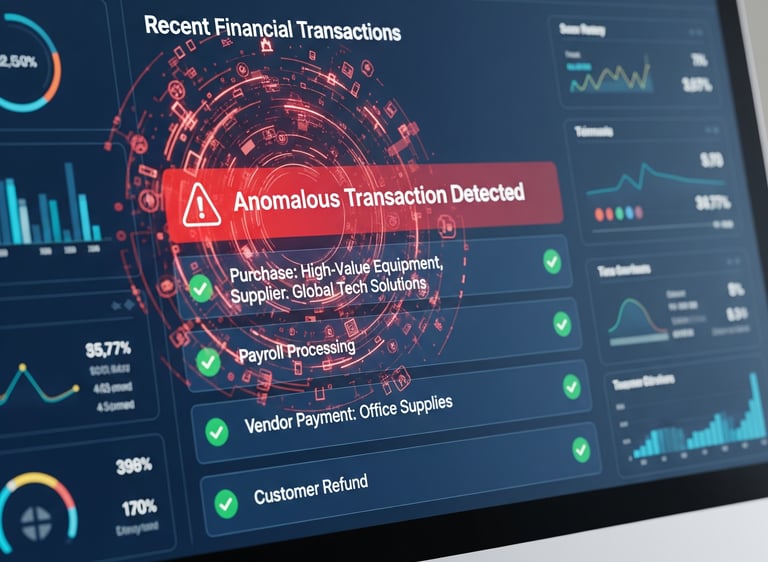
Let's face it: fraud is a constant headache. Traditional fraud systems are like bouncers with a simple checklist—they'll stop anyone who looks suspicious based on a few rules, but clever scammers know exactly how to sneak past them. These old-school rules are no match for today's evolving scams.
This is where AI becomes your secret weapon. It doesn’t just follow rigid rules; it learns the unique "financial fingerprint" of your business operations. AI analyzes everything—from your usual vendor payments and employee spending patterns to the timing and frequency of transactions. It builds a behavioural profile that allows it to instantly spot the slightest sign of a threat.
Imagine this all-too-common scenario in India: you're a bank customer who normally buys groceries and pays bills online. Then, suddenly, a large international transfer is attempted to a random account. The AI system instantly flags this as completely out of character. It doesn't just block the transaction; it immediately sends you an SMS alert or a call from your bank to
confirm if it's really you. This simple, proactive step stops fraud cold, preventing your money from ever leaving your account.
In today's fast-paced digital world, this kind of real-time vigilance isn't a luxury—it's a necessity. AI-powered fraud detection is the smartest way for businesses and banks to protect themselves and give you peace of mind.
Strengthening Processes and Controls with AI
We all know the startup mantra: "move fast and break things." And while that mindset can be great for early growth, it can also leave gaping holes in your financial processes. Overlooked compliance risks, small errors, and manual oversights can snowball into costly errors or even regulatory penalties down the line.
But what if you didn’t have to choose between speed and safety? That's the power of AI as your internal financial watchdog. It goes beyond simple automation and actively safeguards your financial processes and controls. AI systems are like a tireless auditor, continuously monitoring transactions and workflows in real time to ensure they comply with your company's rules.
For example, before a payment is processed, AI can automatically verify that necessary approvals are in place and that the expense report aligns perfectly with company policy. Over time, AI learns from your historical data, getting smarter at catching potential red flags early. This proactive oversight dramatically reduces audit findings and eliminates those unwelcome surprises that can pop up at the worst possible time.
This constant monitoring isn't just about playing it safe; it’s about smart growth. By analyzing where errors or delays frequently occur, AI helps you identify the root causes and make data-driven improvements. This allows your finance operations to become leaner, more resilient, and better equipped to scale with confidence, building a robust financial foundation for the future.
But It’s Not Magic — Success Depends on People and Data
For all the incredible things AI can do, it's crucial to remember one thing: it's a powerful tool, not a magic wand. Simply buying the software won't solve all your problems.
For AI to really shine, it needs a solid foundation—and that foundation is data. AI systems are only as good as the information you feed them. So, before you can unlock AI's potential, you might need to tackle the messy, often overlooked gaps in your data quality. This "spring cleaning" of your accounting data might seem like a lot of work, but it pays off in huge ways, not just for AI but for all your financial reporting.
And then there's the human factor. Bringing AI into your finance team isn't just a tech upgrade; it’s a cultural shift. It means learning new tools, trusting automated processes, and fundamentally changing how you work. For many, this can be a bigger challenge than the technology itself.


Here’s a thought: Imagine your long-time accountant who knows your business inside and out. They might give you a little leeway on a minor expense report issue because they understand the bigger picture. Now, picture AI—it doesn't cut any slack. It strictly follows the rules, flags every single exception, and never misses a beat. That’s both the incredible power and the main challenge of AI in finance: perfectly consistent, but sometimes less forgiving than human judgment.
But for those who embrace this journey, the rewards are immense: you'll get faster closes, fewer mistakes, and more impactful insights that truly move the needle.
What AI Means for Future Accountants
So what does this AI revolution mean if you’re an aspiring accountant or finance professional?
For starters, the nature of the work is shifting. The future accountant won’t spend hours punching numbers or reconciling spreadsheets. Instead, you’ll be working alongside AI systems—focusing on interpreting the insights they provide, spotting strategic opportunities, and advising business leaders.
Your role will be much more about critical thinking, communication, and problem-solving—skills that machines can’t replicate. You’ll become a trusted advisor who helps businesses navigate complexity and uncertainty, using data to tell compelling stories and make confident decisions.
In short, AI isn’t replacing accountants—it’s elevating the profession to a whole new level.
The Bottom Line: AI Is Making Accounting Smarter and More Strategic
AI is quietly revolutionizing accounting and finance by automating the boring, surfacing insights that matter, enhancing fraud detection, and strengthening processes and controls.
More importantly, it frees finance professionals from repetitive work so they can become true strategic partners in the business—helping guide companies toward a more profitable, resilient, and secure future.
But with this new power comes new responsibility. As AI becomes an integral part of how we manage money, it's raising critical questions: How is AI reshaping the audit process, and what new risks are emerging? And how can companies best prepare their finance functions to thrive in this new AI-driven era?
In our next two parts, we'll dive into these crucial questions.
Get in touch
Feel free to reach out – we look forward to connecting!


Services
Contact
Subscribe to our newsletter
© 2024. All rights reserved.
External Links
+91 9490229229
info@ukaca.in